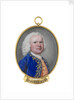
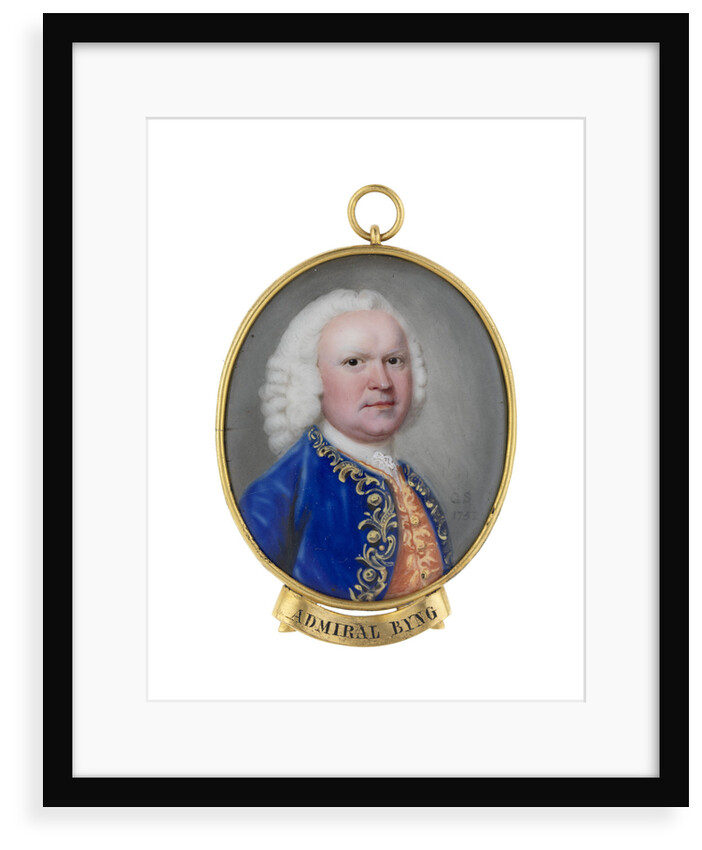
Admiral the Honourable John Byng (1707-1757)
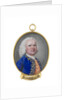
Image information
Sizing information
| Overall size (inc frame) | x cm ( x in) |
| Depth | cm (in) |
| Artwork | x cm ( x in) |
| Border (mount) |
cm
top/bottom
(in)
cm left/right (in) |
| The paper size of our wall art shipped from the US is sized to the nearest inch. | |

Admiral the Honourable John Byng (1707-1757)
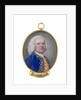
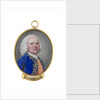
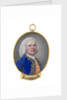
An oval bust-length enamel miniature in an oval gilt metal display frame, with a suspension ring, and a scroll label below inscribed ADMIRAL BYNG. The inscription 'BYNG' also appears on the back of the frame and the image itself is signed and dated 'G.S. 1752.' The sitter is shown half-turned to his left, but facing out to the viewer. He wears a gold-braided blue coat (apparently not uniform), a gold-embroidered waistcoat and a mid-length white wig. John Byng was the fourth son of a more distinguished naval father, Admiral George Byng, 1st Viscount Torrington. He entered the Navy in 1718 and spent much of his career in the Mediterranean including as commander-in-chief, 1747-1748. His tragedy was that he had limited experience of senior command, especially in action, and it was family connection rather than proven ability which saw him promoted beyond his tested competence. This was proved in 1756 at the start of the Seven Years War, when he was sent, with inadequate forces and false assurances of further support and supplies from Gibraltar, to lift the French siege of Minorca. Gibraltar proved a broken reed and off Minorca he fought an unskilful and inconclusive action, itself not unusual, which failed to dislodge the French naval blockade. He then made the mistake of calling a council of war and following his officers' view that nothing further could be done. As a result, Minorca, Britain's sole foothold east of Gibraltar, was lost. On return home Byng found himself popularly charged with cowardice and formally with the capital offence of 'failing to do his utmost' in the face of the enemy. He was convicted by court-martial on the point of law but with strong recommendations for mercy, since the court understood the difficulties he had faced. Given the political storm, however, George II refused to commute the death sentence. On 14 March 1757 Byng was shot on the deck of his flagship 'Monarch' at Portsmouth, prompting Voltaire's famous remark, (in 'Candide'), that in England 'it is thought good to shoot an admiral from time to time to encourage the others'. Gervase Spencer (circa 1715-1763), was originally a domestic servant, whose employers encouraged his interest in painting miniatures and, as was then the practice in England, largely taught himself, including the difficult and quite expensive process of working in enamel. His earliest date from about 1745 and he became the leading London practictioner of the form by the time of his death, though he exhibited relatively little because of lack of public opportunity until the 1760s. Gervase Spencer
- Image reference: F9510
- National Maritime Museum, Greenwich, London
Discover more
More by this artist
Search for similar images
Product images of Admiral the Honourable John Byng (1707-1757)




Our framed prints
Every framed picture is created by hand in our workshop by specialist framers.
Black, white, brown, silver, gold or natural frames available, supplied ready to hang.
All our frames have a smooth satin finish, and measure 20mm (front face) by 23mm (depth from wall).
Read more about our framed art prints.
Manufactured in the UK
All products are printed in the UK, using the latest digital presses and a giclée printmaking process.
We only use premium branded inks, and colours are independently verified to last between 100 and 200 years.
Delivery & returns
We print everything to order so delivery times may vary but all framed pictures are despatched within 5-7 days via courier or recorded mail.
Due to the coronovirus pandemic and Brexit situation, current shipping times may be longer, particularly for destinations outside the UK.
Delivery to the UK is £10 for a single framed print.
We will happily replace your order if everything isn’t 100% perfect.