
Airy transit circle

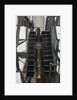
Image information
Sizing information
| Overall size (inc frame) | x cm ( x in) |
| Depth | cm (in) |
| Artwork | x cm ( x in) |
| Border (mount) |
cm
top/bottom
(in)
cm left/right (in) |
| The paper size of our wall art shipped from the US is sized to the nearest inch. | |

Airy transit circle
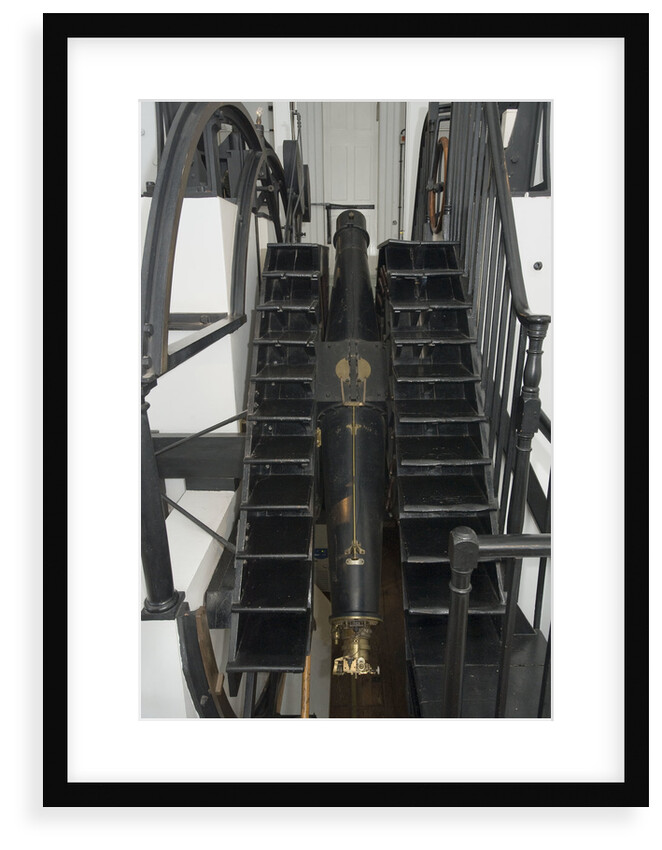
This telescope was originally proposed as a more accurate, more modern version of the transit instrument introduced by the Astronomer Royal, John Pond [AST0982]. Constructing Airy's huge transit circle was a major undertaking. The engineering was carried out by agricultural machinery experts, Ransomes & May of Ipswich while prestigious London instrument makers, Troughton & Simms constructed both the optical parts (including the 206 mm object lens) and the main body. As a whole however the instrument was designed by then Astronomer Royal, Sir George Biddell Airy.
The telescope was first used on 4th January 1851. Airy had intended for it to come into use on the 1st day of the new half century but bad weather prevented it. The transit circle was in continuous use until 1938& in 1954 the last official observation was made (by Gilbert Satterthwaite). The telescope was used to observe clock stars which provide the basis for GMT predominantly. It was also used to observe the Sun, Moon, planets & minor planets & other stars to improve knowledge of their positions and proper motion. In 1880 GMT based on the meridian of this instrument was made legal time in the UK & in 1884 it became the prime meridian of the world. The telescope was generally operated by two observers, one on the telescope, the other on the circle microscopes.
As the transit circle was not wall mounted, repeated use often meant that the telescope fell out of true vertical alignment and needed to be realigned (or collimated) weekly. From 1854, a recording apparatus, or chronograph, was introduced to record its observations on a rolling drum of graph paper. The last observation was taken in 1954 just before the astronomers finally left the bright lights and polluted skies of Greenwich for their new site on the grounds of Herstmonceux Castle in Sussex.
Troughton & Simms
- Image reference: L2156-002
- National Maritime Museum, Greenwich, London
Discover more
More by this artist
Search for similar images
Product images of Airy transit circle



Our framed prints
Every framed picture is created by hand in our workshop by specialist framers.
Black, white, brown, silver, gold or natural frames available, supplied ready to hang.
All our frames have a smooth satin finish, and measure 20mm (front face) by 23mm (depth from wall).
Read more about our framed art prints.
Manufactured in the UK
All products are printed in the UK, using the latest digital presses and a giclée printmaking process.
We only use premium branded inks, and colours are independently verified to last between 100 and 200 years.
Delivery & returns
We print everything to order so delivery times may vary but all framed pictures are despatched within 5-7 days via courier or recorded mail.
Due to the coronovirus pandemic and Brexit situation, current shipping times may be longer, particularly for destinations outside the UK.
Delivery to the UK is £10 for a single framed print.
We will happily replace your order if everything isn’t 100% perfect.