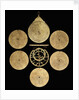
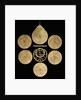
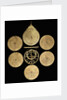
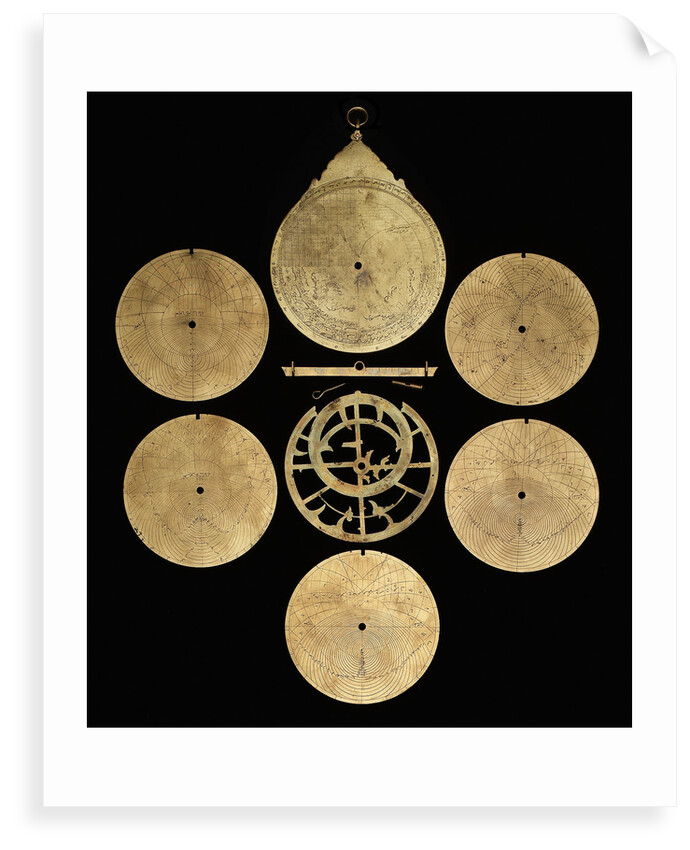
Astrolabe: dismounted reverse
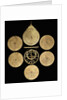
Image information
Sizing information
| Overall size (inc frame) | x cm ( x in) |
| Depth | cm (in) |
| Artwork | x cm ( x in) |
| Border (mount) |
cm
top/bottom
(in)
cm left/right (in) |
| The paper size of our wall art shipped from the US is sized to the nearest inch. | |

Astrolabe: dismounted reverse
This fine astrolabe belongs to the earliest tradition of instrument making at the Moghul court in Lahore and is dateable to the second half of the 16th century. It shares several characteristics of an astrolabe by Ilahdad (Salar Jung Museum, Hyderabad [IC no. 1120]) and so it is probable that he may have been the maker. The various markings on the instrument reveal the work of two different engravers from the same Moghul milieu: the main engraver (perhaps Ilahdad himself) engraved the limbus and the gazetteer, as well as the rete and three of the five plates, while the second person completed the markings on the back of the instrument and the remaining two plates.
- Image reference: E5545-2
- National Maritime Museum, Greenwich, London
Discover more
More by this artist
Search for similar images
Product images of Astrolabe: dismounted reverse



Our prints
We use a 240gsm fine art paper and premium branded inks to create the perfect reproduction.
Our expertise and use of high-quality materials means that our print colours are independently verified to last between 100 and 200 years.
Read more about our fine art prints.
Manufactured in the UK
All products are printed in the UK, using the latest digital presses and a giclée printmaking process.
We only use premium branded inks, and colours are independently verified to last between 100 and 200 years.
Delivery & returns
We print everything to order so delivery times may vary but all unframed prints are despatched within 2-4 days via courier or recorded mail.
Due to the coronovirus pandemic and Brexit situation, current shipping times may be longer, particularly for destinations outside the UK.
Delivery to the UK is £5 for an unframed print of any size.
We will happily replace your order if everything isn’t 100% perfect.