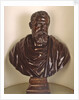
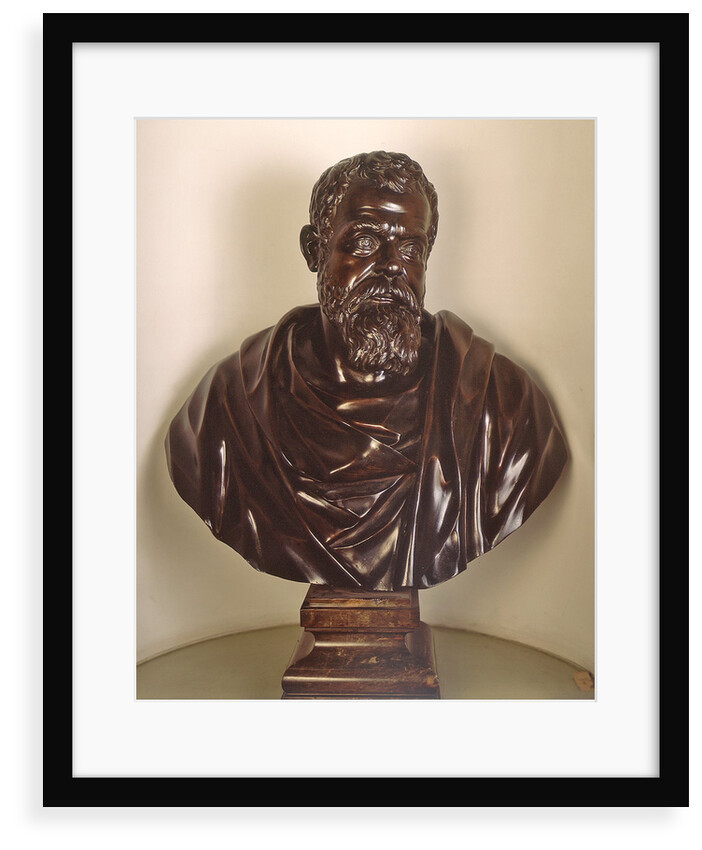
Galileo Galilei (1564-1642)
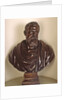
Image information
Sizing information
| Overall size (inc frame) | x cm ( x in) |
| Depth | cm (in) |
| Artwork | x cm ( x in) |
| Border (mount) |
cm
top/bottom
(in)
cm left/right (in) |
| The paper size of our wall art shipped from the US is sized to the nearest inch. | |

Galileo Galilei (1564-1642)
Head-and-shoulders bronze bust of Galileo, the Pisan-born experimental natural philosopher and astronomer, purchased for the Museum as part of the Gabb Collection of scientific instruments by Sir James Caird. This was concluded late in 1936, though the formal acquisition date is February 1937. Galileo is shown in classical philosopher style, the shoulders fully robed round, the sitter's head facing slightly to his left. The bronze is finished by light chiselling and was previously gilt, traces of which remain, and stands on a square brown marble socle (which previous notes record as green). The received attribution was to the Florentine, Pietro Tacca (1557-1640), about 1608, which was suggested by its early 20th-century owner, the British collector Max Rosenheim FSA (1849 -1911). Tacca was a pupil and assistant of Giambologna from 1592 and after his death in 1608 succeeded him as court sculptor to the Medici Grand Dukes of Tuscany, at which time he would certainly have known Galileo, who became became court philosopher and mathemetician to Cosimo II de' Medici in 1610. However, J. J. Fahie ( 'Memorials of Galileo Galilei 1564-1642...'[London, 1929] pp. 123-26), while noting uncertainty on the Tacca attribution, showed that it derives from a plaster prototype of 1612 by Giovanni Caccini (1556-1612/14), which Galileo himself approved and which was intended as model for a marble that Caccini's death forestalled. This plaster has been in Trinity College, Cambridge, since 1759 but in the 1660s is presumed to have been in possession of Galileo's disciple and posthumous champion, Vincenzo Viviani (d. 1703). It has more recently been established that Viviani had two bronze busts made from it by Lodovico Salvetti as part of his unsuccessful campaign to create monumental tomb for Galileo, and that he intended to present one to Louis XIV of France, with a dedicated life and works of Galileo, in return for a generous pension Louis had given him. This did not happen, for various reasons, and in 1674 Viviani is recorded as giving such a bronze to the Galleria Medicea in Florence. However, when Antonio Favaro (1847-1922), the 19th-century editor of Galileo, later investigated this he found no trace of the donation or of such a bust in that collection; nor was any such bronze still in Viviani's possession at his death. Assuming that this is one of the Salvettis, it presumably also left VIviani's possession before 1703, and later Italy. What happened to the other is not known and this one only re-emerged in about 1906, when Rosenheim found it in use as a garden sculpture in the west of England. He bought it, confirmed the subject as Galileo and attributed it to Tacca, and it subsequently passed to his brother Maurice Rosenheim FSA (1852-1922). Fahie in 1929 believed it still in the latter's family, after whom George Gabb was presumably the next private owner, but there were several Rosenheim sales at Sotheby's in May 1923, which may also have been Gabb's source. Salvetti was a minor Florentine sculptor who was an apprentice in Giambologna's and Tacca's workshop before becoming assistant to the latter, but even his dates are uncertain. His work in marble included restoration of antique pieces but his two masters were best known for their work in bronze. This reasonably explains Roseheim's belief, based on comparative evidence, that it was by Tacca though no other bust of Galileo by him is known.
Lodovico Salvetti
- Image reference: D7078
- National Maritime Museum, Greenwich, London, Caird Collection
Discover more
More by this artist
Search for similar images
Product images of Galileo Galilei (1564-1642)



Our framed prints
Every framed picture is created by hand in our workshop by specialist framers.
Black, white, brown, silver, gold or natural frames available, supplied ready to hang.
All our frames have a smooth satin finish, and measure 20mm (front face) by 23mm (depth from wall).
Read more about our framed art prints.
Manufactured in the UK
All products are printed in the UK, using the latest digital presses and a giclée printmaking process.
We only use premium branded inks, and colours are independently verified to last between 100 and 200 years.
Delivery & returns
We print everything to order so delivery times may vary but all framed pictures are despatched within 5-7 days via courier or recorded mail.
Due to the coronovirus pandemic and Brexit situation, current shipping times may be longer, particularly for destinations outside the UK.
Delivery to the UK is £10 for a single framed print.
We will happily replace your order if everything isn’t 100% perfect.