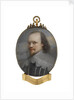
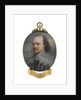
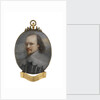
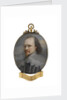
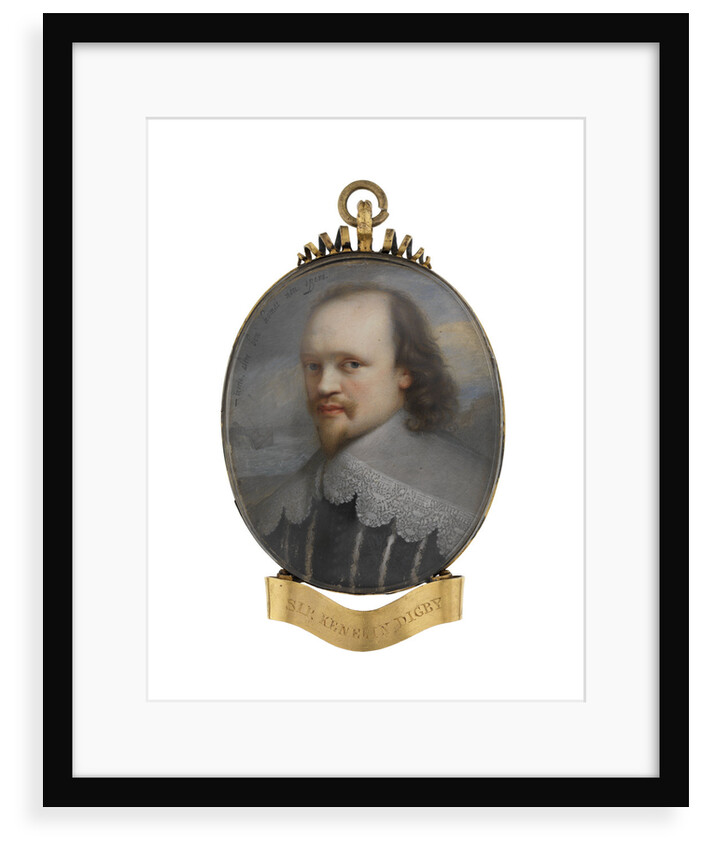
Sir Kenelm Digby (1603-1665)
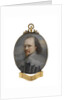
Image information
Sizing information
| Overall size (inc frame) | x cm ( x in) |
| Depth | cm (in) |
| Artwork | x cm ( x in) |
| Border (mount) |
cm
top/bottom
(in)
cm left/right (in) |
| The paper size of our wall art shipped from the US is sized to the nearest inch. | |

Sir Kenelm Digby (1603-1665)
An oval miniature in watercolour on vellum in an oval gilt metal display frame, with a coiled upper mount for the suspension ring and a scroll label below engraved 'SIR KENELIN DIGBY'. Digby is shown head and part shoulders, half turned to his right but looking out to the viewer, wearing a broad starched white collar with a lace edge over a (mourning), doublet of black-laced vertical bands alternating with narrow white ones. He has blue eyes, receding reddish hair worn long at the back, and a beard and moustache in the Charles I style. The grey-tone background shows a rocky coast, with a ship sinking against a rock in the sea to the left and another partly seen, stern on, to the left of Digby's head. There is an Italian inscription round the upper left edge: 'morte; altro ben' homai non spero' (death; henceforth I hope for nothing better). With his apparent age and the loss of one vessel of two behind, on a calm sea, this may allude to Digby's grief after the sudden, unheralded death of his wife from a stroke early in 1633, when he wrote to his brother that 'I can have no physician but death'. The maritime alluson itself probabaly refers to his previous experience as a privateer commander and as a member of the Navy Board from about 1630. Digby was a courtier, soldier and natural philosopher, of an old Catholic family. His father, Sir Everard, was executed as one of the 'gunpowder plotters' but had secured his estates against forfeit. Kenelm was educated at Oxford and on the Grand Tour. In Paris, Queen Marie de Medicis became infatuated with him, from which he escaped to Florence and later joined his cousin, the Earl of Bristol, in Spain where he helped in Prince Charles's unsuccessful suit to marry the Spanish Infanta. On return home he became a gentleman of the prince's privy chamber and was knighted. He was subsequently involved in the arrangements of Charles's marriage to Henrietta Maria of France in 1624 and himself secretly married his childhood friend (and current lover), Venetia Stanley, in 1625. This was only made public after the birth of their second son early in 1628, when he commanded a privateering voyage against the French and Spanish in the Mediterranean, returning rich and a hero in February 1829. He thereafter largely spent the 1630s in academic, literary and philosophical enquiries, becoming again a firm Catholic after a brief Protestant dalliance and the death of his wife, which deeply affected him, he never remarried. In the Civil War, Digby raised money for the Royalist cause but was arrested and spent his time in prison writing. On release he went to France where he became Henrietta Maria's chancellor in exile, helped further fund-raising from the Pope with little success, and also corresponded as an intermediary with the Parlamentary regime to plead for Catholic toleration. In 1653 he returned to England and was an intermediary between Cromwell and Cardinal Mazarin of France. After his final return to England at the Restoration, in 1660, he was one of the founders of the Royal Society. Digby wrote a number of significant works of natural philosophy. Of charismatic personal qualities, he was a key 'Renaissance' figure in the English transition from the medieval age of magic to that of Enlightenment reason. He inherited a vast and valuable library from scholarly friends, from which he made generous donations to both the Bodleian Library, Oxford, and that of Harvard University at its foundation. Many portraits of him exist, including by van Dyck. Hoskins, called 'Old' or the Elder (c. 1590-1665), was painter and later a miniaturist, a skill he probably learnt from Hilliard, and passed on both to his son, John the younger, and his nephews and pupils Samuel and Alexander Cooper. Purchased for the Museum by Sir James Caird in 1941 from the Duke of Buccleuch.
John Hoskins
- Image reference: F9526
- National Maritime Museum, Greenwich, London, Caird Collection
Discover more
More by this artist
Search for similar images
Product images of Sir Kenelm Digby (1603-1665)




Our framed prints
Every framed picture is created by hand in our workshop by specialist framers.
Black, white, brown, silver, gold or natural frames available, supplied ready to hang.
All our frames have a smooth satin finish, and measure 20mm (front face) by 23mm (depth from wall).
Read more about our framed art prints.
Manufactured in the UK
All products are printed in the UK, using the latest digital presses and a giclée printmaking process.
We only use premium branded inks, and colours are independently verified to last between 100 and 200 years.
Delivery & returns
We print everything to order so delivery times may vary but all framed pictures are despatched within 5-7 days via courier or recorded mail.
Due to the coronovirus pandemic and Brexit situation, current shipping times may be longer, particularly for destinations outside the UK.
Delivery to the UK is £10 for a single framed print.
We will happily replace your order if everything isn’t 100% perfect.