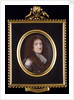
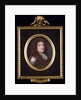
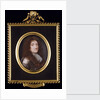
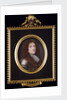

Prince Rupert (1619 -1682), Count Palatine of the Rhine, Duke of Cumberland
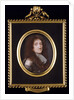
Image information
Sizing information
| Overall size (inc frame) | x cm ( x in) |
| Depth | cm (in) |
| Artwork | x cm ( x in) |
| Border (mount) |
cm
top/bottom
(in)
cm left/right (in) |
| The paper size of our wall art shipped from the US is sized to the nearest inch. | |

Prince Rupert (1619 -1682), Count Palatine of the Rhine, Duke of Cumberland
Oval miniataure in watercolour, in a gilded oval surround set in a black wooden rectangular backing and a moulded and gilded outer frame, with decorative ribbon decoration above. An engraved and black-lettered name scroll below is inscribed: 'PRINCE RUPERT. / BY SAMUEL COOPER'. There is also a label on the back of the frame bearing the inscription 'W3 56'. The sitter is shown head and shoulders turned to his left with only the right shoulder visible, but facing out to the viewer. He wears gilt-studded armour, a white-lace neckcloth and probably a undressed long auburn wig of which the colour matches his eyebrows, suggesting natural hair. The eyes are also brown; the down-turned mouth suggests a slightly undershot jaw and the overall impression is of fatigue and a 'face hardened by years of strenuous fighting', as H. A Kennedy put it in his 1917 'Studio' monograph on the miniatures in the Buccleuch collection, from which this comes (p.17).
Rupert was third son of Princess Elizabeth, daughter of James I and later 'Winter' Queen of Bohemia. He was therefore a nephew of King Charles I, fighting for his uncle throughout the Civil War (1642-1649) principally as a cavalry commander, and as commander-in-chief of the Royalist land forces in 1644. He was a brave and skilled, though sometimes rash, commander whose thunderbolt charges made him a terrifying legend, though not one eventually to prevail against the greater discipline and resources of Cromwell and the New Model Army. At the end of the war he took command of the loyalist remnants of the fleet and, despite defeat by Blake in 1650, carried on the conflict for several years based largely in the Channel Islands. Under Charles II, he held high fleet commands in the Restoration navy, fighting in the Second and Third Dutch Wars and becoming Lord High Admiral on the Duke of York's enforced retirement in 1673. Rupert was a man of considerable artistic talent and intellectual curiosity, and (like his cousin Charles II) a patron of science, often conducting experiments himself , notably in metallurgy: he was also one of the foundation members of the Royal Society. Feared during during the Civil War, he remained a figure of controversy - alienating many who could have helped him through lack of diplomatic temper, and (as a foreigner) never entirely trusted at a popular level. He was loyal to England as his adopted home, however, and to his cousin Charles II, who gave him an income of Õú6000 a year and in 1668 made him Governor of Windsor Castle, which he did much to repair. He also held the titles of Duke of Cumberland and Earl of Holderness. Rupert never married but had an illegitimate son, Dudley Bard (1667-86) who was also a soldier and died at the Siege of Buda, and a daughter, Ruperta, by the actress Margaret Hughes (d. 1719) who was his mistress from about 1668 and was said to have 'brought down and greatly subdued his natural fierceness'. At his death, from a chest infection caught while at the theatre, he left 'Mrs Hughes and her daughter' the bulk of the considerable estate he had by then amassed.
The date of this item is presumably after the Restoration of 1660, and perhaps most dependent on assessment of the sitter's age, though the armour may suggest about the time of the Second Dutch War (1664-1667).
Samuel Cooper
- Image reference: D9206
- National Maritime Museum, Greenwich, London, Caird Collection
Discover more
More by this artist
Search for similar images
Product images of Prince Rupert (1619 -1682), Count Palatine of the Rhine, Duke of Cumberland



Our prints
We use a 240gsm fine art paper and premium branded inks to create the perfect reproduction.
Our expertise and use of high-quality materials means that our print colours are independently verified to last between 100 and 200 years.
Read more about our fine art prints.
Manufactured in the UK
All products are printed in the UK, using the latest digital presses and a giclée printmaking process.
We only use premium branded inks, and colours are independently verified to last between 100 and 200 years.
Delivery & returns
We print everything to order so delivery times may vary but all unframed prints are despatched within 2-4 days via courier or recorded mail.
Due to the coronovirus pandemic and Brexit situation, current shipping times may be longer, particularly for destinations outside the UK.
Delivery to the UK is £5 for an unframed print of any size.
We will happily replace your order if everything isn’t 100% perfect.