Transit instrument
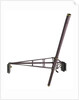
Image information
Sizing information
| Overall size (inc frame) | x cm ( x in) |
| Depth | cm (in) |
| Artwork | x cm ( x in) |
| Border (mount) |
cm
top/bottom
(in)
cm left/right (in) |
| The paper size of our wall art shipped from the US is sized to the nearest inch. | |

Transit instrument
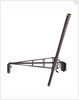
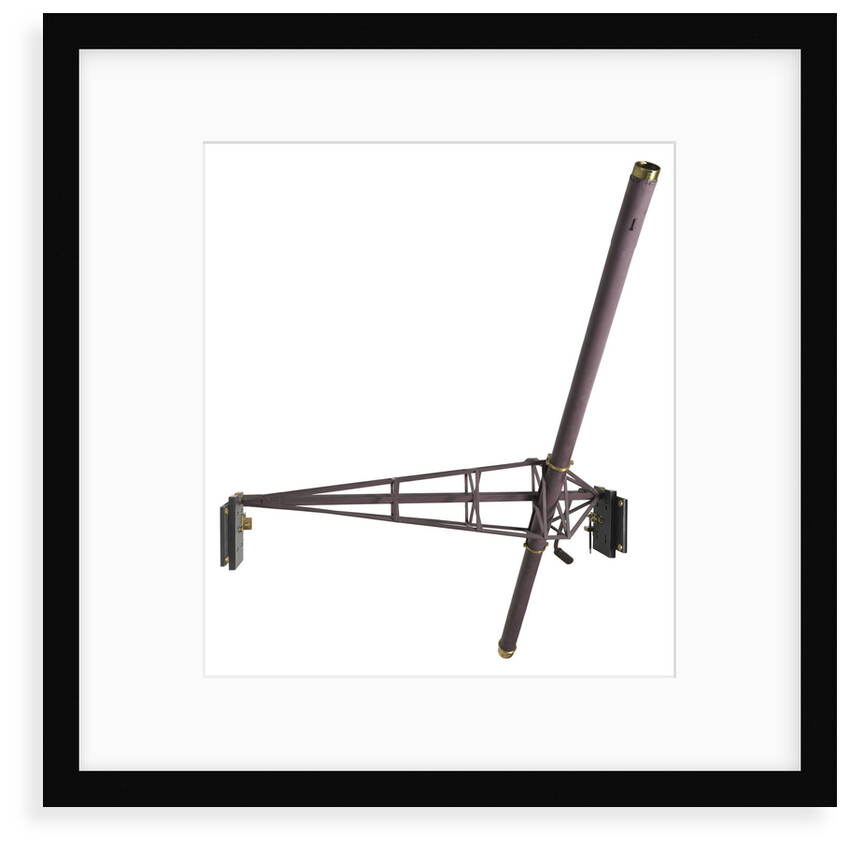
The earliest telescope at the Royal Observatory Greenwich that can definitely be associated with its history, apart from the remains of John Flamsteed's well telescope, is this 5ft transit instrument purchased by Edmond Halley, the second Astronomer Royal. When Halley arrived at the Observatory in 1720 he discovered that Flamsteed's widow had removed all the instruments, which she saw as personal property. Halley managed to obtain a grant of ├ò├║500 from the Board of Ordnance for re-equipping the observatory and this was one of the first items that he ordered.Instruments of this sort were a relatively recent invention by Olaus RÔòá┬¬mer, professor of astronomy at the University of Copenhagen, and Halley's may have been the first made in England. Lighter and less expensive than a mural quadrant, their disadvantage was that they could easily become misaligned through slight changes in temperature. However, Halley's instrument proved useful and remained in service, with modifications, until 1750.A transit instrument is a telescope pivoted on a stand so that it can only move in one plane. Normally it would be aligned north-south so that, as the Earth turns, every star visible from the latitude of the telescope can be seen to rise and fall over the course of a year. Such telescopes were used, together with a very precise clock (an astronomical regulator), to create accurate star catalogues and charts. The co-ordinates of each star are provided by the time at which it crosses the meridian and the angle at which the telescope is pointing when it is viewed. This transit instrument has no angle scale so a separate instrument, such as Halley's mural quadrant (AST0970), must be used alongside.This telescope consists of a brass tube, 5ft (168cm) in length, with an object glass aperture of 1.5 inches (4cm) and magnification of less than x 40. The object glass survives but the eyepiece is missing. It is mounted on an off-centre axis supported by braces that would have attached to two north-south aligned walls or piers. The maker is not known, although one account suggests that Robert Hooke (who died in 1702) may have been responsible for at least part. George Graham, who made Halley's mural quadrant, may have completed or mounted the instrument.George Graham
- Image reference: F8673
- National Maritime Museum, Greenwich, London
Discover more
More by this artist
Search for similar images
Product images of Transit instrument



Our framed prints
Every framed picture is created by hand in our workshop by specialist framers.
Black, white, brown, silver, gold or natural frames available, supplied ready to hang.
All our frames have a smooth satin finish, and measure 20mm (front face) by 23mm (depth from wall).
Read more about our framed art prints.
Manufactured in the UK
All products are printed in the UK, using the latest digital presses and a giclée printmaking process.
We only use premium branded inks, and colours are independently verified to last between 100 and 200 years.
Delivery & returns
We print everything to order so delivery times may vary but all framed pictures are despatched within 5-7 days via courier or recorded mail.
Due to the coronovirus pandemic and Brexit situation, current shipping times may be longer, particularly for destinations outside the UK.
Delivery to the UK is £10 for a single framed print.
We will happily replace your order if everything isn’t 100% perfect.