
Zenith sector

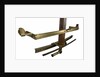
Image information
Sizing information
| Overall size (inc frame) | x cm ( x in) |
| Depth | cm (in) |
| Artwork | x cm ( x in) |
| Border (mount) |
cm
top/bottom
(in)
cm left/right (in) |
| The paper size of our wall art shipped from the US is sized to the nearest inch. | |

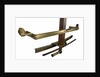
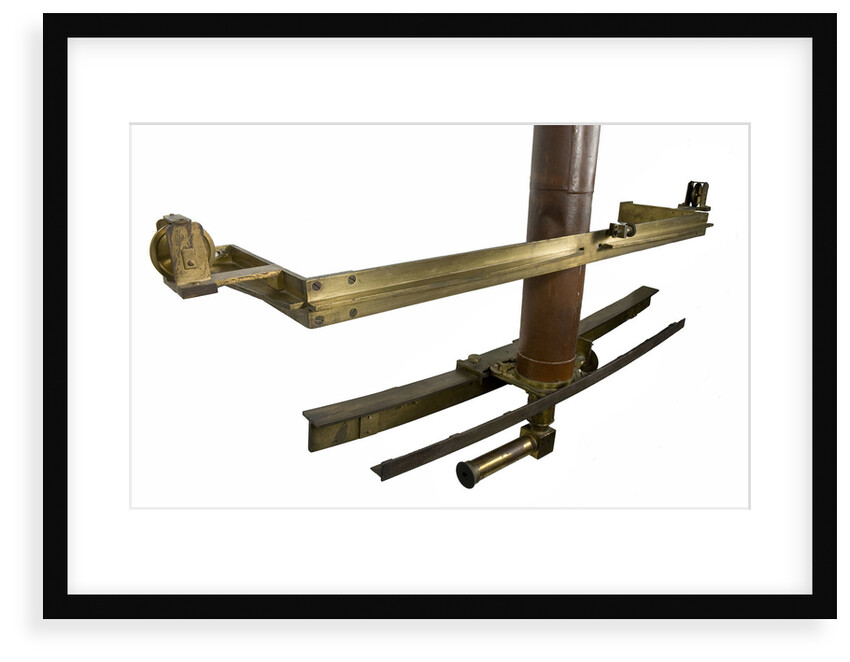
Zenith sector
This zenith sector telescope was constructed by George Graham in 1727 for Bradley's personal use in studying the parallax of the star Gamma Draconis following work he had begun on the detection of parallax at Kew with Samuel Molyneux. When he was appointed third Astronomer Royal in 1742, Bradley only agreed to bring this instrument to Greenwich after the Government paid him the princely sum of £45 for it. With it he discovered two major phenomena: the aberration of light and the nutation (wobbling) of the Earth's axis. It was used at Greenwich until 1837. It was then used at the Observatory at the Cape of Good Hope between 1837 and 1839.
Before Bradley became Astronomer Royal he worked with Samuel Molyneux investigating parallax, that is, attempting to use trigonometry to discover the size of the solar system by observing just one star from a fixed position to see how it moved. The atmosphere makes the light from stars bend, which makes them appear in a different position to where they actually are. This bending is greatest at the horizon, and non-existent at the zenith, straight overhead. Therefore, to make very accurate observations of a single star, for example for parallax observations, a zenith sector is the best instrument to use. This zenith sector was made by George Graham in 1727 and first used by Bradley at Wanstead, Essex, and when Bradley became Astronomer Royal in 1742 it was brought to Greenwich. It was with this instrument that, in 1729, while trying to detect parallax, Bradley instead discovered the aberration of light & nutation
George Graham
Original size: 3810 mm x 72 mm
- Image reference: L3368-007
- National Maritime Museum, Greenwich, London
Discover more
More by this artist
Search for similar images
Product images of Zenith sector



Our framed prints
Every framed picture is created by hand in our workshop by specialist framers.
Black, white, brown, silver, gold or natural frames available, supplied ready to hang.
All our frames have a smooth satin finish, and measure 20mm (front face) by 23mm (depth from wall).
Read more about our framed art prints.
Manufactured in the UK
All products are printed in the UK, using the latest digital presses and a giclée printmaking process.
We only use premium branded inks, and colours are independently verified to last between 100 and 200 years.
Delivery & returns
We print everything to order so delivery times may vary but all framed pictures are despatched within 5-7 days via courier or recorded mail.
Due to the coronovirus pandemic and Brexit situation, current shipping times may be longer, particularly for destinations outside the UK.
Delivery to the UK is £10 for a single framed print.
We will happily replace your order if everything isn’t 100% perfect.